
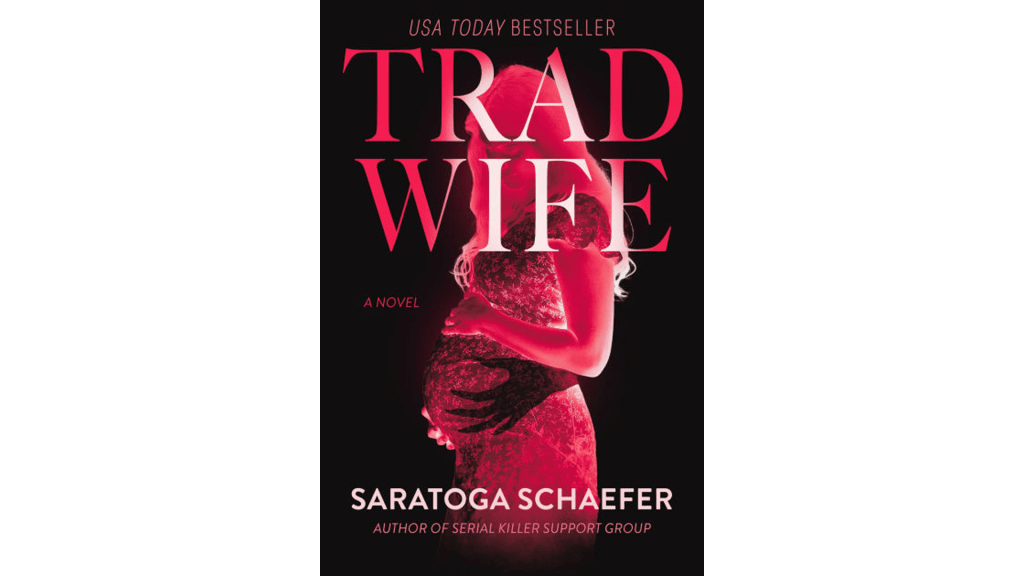
I couldn’t put down this book. As a lifelong fan of horror, the premise hooked me immediately, and having a Spotify Premium account, I listened to the entire 11-hour audiobook in about three sittings.
To summarize, Trad Wife centers around Camille, a 20-something social media influencer deeply entrenched in the “tradwife” lifestyle; she keeps house, cooks all meals from scratch, maintains an angelic appearance 24/7, and always submits to her husband. The only thing she’s missing is a child, and unfortunately, in her passionless marriage to Graham, conception is continually out of reach. Enter a mysterious Wishing Well, from which a dark spirit emerges to grant Camille’s only desire; a midnight liaison with the creature, while her husband is “at a friend’s house,” leaves Camille pregnant at last. Now everything ought to fall into place, right?
Well, it’s a horror story, so of course not. What follows is a supernatural body horror with elements of a monster romance, in which Camille’s pregnancy drives her to eat raw meat, vomit mysterious substances in morning sickness, and avoid her husband’s Catholic church at all costs. And that’s only the first half.
The prose throughout is quite good, beautiful in some passages, a bit hastened and clichéd in others. The story simmers nicely through the first half of the novel, drags a little after we reach the midpoint, before finally picking up steam and racing toward a dark and unnerving, yet emotionally sound conclusion. I will say that I’m not in love with first person present tense. It works for the purposes of this novel, but there were several times I was left wishing to get out of Camille’s head. Perhaps that is the point; I felt like I was joining her in her tradwife imprisonment. At times I couldn’t stand her as a cellmate. At times I pitied her. At times I could only look at her incredulously; she can be quite clever, but at other times, she’s the dumbest human being in the world. I suppose that is the lot of a majority of horror protagonists, unfortunately.
Schaefer presents us with a small cast of only a handful of other characters, namely Graham, Renee, and the creature. Renee is probably the most fun of the supporting cast, while Graham, as the principal antagonist, is shockingly one-note. As a lover of all things monsters, I found myself intrigued with the demonic entity creature (as well as its progeny), and I would have liked to see Camille (who has a background, quite interestingly, in the STEM fields) try to categorize and understand its physiology and biology.
Overall, though, this novel was a rollercoaster of highs and lows, and I was strapped in to the end. I’ll mention that I had to listen to the audiobook at about 1.4x speed, as the narrator spoke devastatingly slow for my digitally-soiled attention span. If you are looking for something truly unnerving to keep you up at night, this book is for you.
Before we continue, please note that there are spoilers from here on out.
Quite clearly one can see the base pairs of this book’s DNA: Rosemary’s Baby and The Omen are obvious comparisons, but I see a lot of Ari Aster’s Midsommar in here, as well as Stephen King’s Carrie and Bret Easton Ellis’ American Psycho. I have not read the Twilight series, but I’m certain there’s some Stephanie Meyer in this book also. Where these stories succeed, and Trad Wife sort of slumps, is in the element of surprise. American Psycho, Carrie, and Midsommar are bold, shocking, disgusting. There was little in Trad Wife that genuinely surprised me.
I can count two particular instances where the author threw a wrench at my head and I had to duck (Camille giving birth right at the start of Part 3, and Sweetheart biting off Camille’s toes), but Schaefer has a tendency to tip her hand too far. As soon as the rolling pin is mentioned after Reneé comes into the kitchen, it’s apparent she will die. Neither was it in any way surprising that she no longer had her kids. As soon as Sweetheart sniffs the air while the cop is in the house, it’s clear he’s going to die as well. The revelation of Graham’s cheating and his subsequent death came as no shock (perhaps it is meant to be ironic that his cheating was so obvious and Camille chose to be oblivious to this). His ending was a bit anticlimactic. Having read the premise, I came into this story expecting to see something new and fresh. It played out as a boilerplate, but very competent, horror slasher. I will add, though, that Sweetheart was a truly unnerving character. Her violent and primal tendencies, tiny needle teeth, white, empty eyes, and meteoric growth spurts is truly the stuff of nightmares.
As stated above, one intersesting thing about Camille is her background in the field of biology. Unfortunately, when these skills in observation and critical thinking are needed most, they become window dressing on her backstory rather than a tool for the present. In fact, Camille is not a very active participant in the story for much of the narrative, save for a key few moments where she truly propels the story forward. For me, this is why the story dragged a bit following the birth of Sweetheart. I fear that the author had to downplay Camille’s scientific curiosity in order for the events of the story to unfold as they did. For God’s sake, Camille, you knew you should have seen a doctor.
The same goes for Camille’s personal brand as a tradwife; I’ve seen a blurb call this novel “Rosemary’s Baby for the digital age,” but near all the second half of the novel takes place offline, save for a few, sparse moments. Camille actually loses all interest in her personal brand as a tradwife, which leaves me to wonder if the social media plot thread was necessary at all; Camille could have just been a submissive homemaker with no online presence, still wishing for a child to make everything “perfect,” and the events of the novel could have played out just as they did. I worry that the author lost interest in this thread as well. With the “tradwife” online aesthetic playing such an important role in the first half of the novel, I expected Camille’s inner unraveling to collide directly with her online persona in spectacular fashion. Rather, she passes out of the online space with scarcely a whisper, save for her final post at the very end, which almost comes as an afterthought.
The ending of this book brings me back to thinking of the film Midsommar. It’s been ages since I’ve watched the film, but if I remember correctly, the audience is not really meant to sympathize with Dani’s choice at the end. She trades her abusive relationship with her boyfriend for another manipulative and volatile relationship with the Harga cultists. It is a tragedy that she feels accepted among such a violent and insular group of people. In similar fashion, Camille of Trad Wife trades her humanity for the same solace of a caring family; the blood price comes with violent retribution, that she might tear down her home’s existing power structure and replace it with her own. In this climactic moment, Camille, embodying a full transformation into the demonic species she has mated with and now birthed, murders and consumes Graham, her human husband. The throughlines of Rage and Hunger are fulfilled in disturbing concert, and when Camille at last sees what she has become, she is pleased, thereafter going outside to at last join her new community of darkness.
My fear, though, is that the book is squeamish about not condoning Camille’s violence; rather, the novel is intended to be cathartic. That is not to say that women trapped in the tradwife lifestyle (or any abusive relationship) should not realize their worth and resist their oppressors; quite the opposite. The fulfillment of Feminist rage and hunger, unfortunately, is something to be seen as scary in the mind of the oppressors, and so I see here what Schaefer is doing in grisly metaphor. But resistance to any form of oppression, whether it be an abusive spouse or a fascist empire, happens through recognizing and honoring one’s own humanity, not killing it to even the playing field. I almost think it would have been more poignant for Graham to survive the story (it at least would have subverted expectations); I would have liked to see him live to see the full magnitude of the darkness that has overtaken his house and yet remain powerless to do anything about it (sans an arm or a leg, maybe. Sweetheart is always hungry).
Now, perhaps this is a symptom of hearing this tale from a narrator undergoing such a metamorphosis of identity, this inability to take accountability for her own choices (even pre-pregnancy) and the harm she’s wrought afterward. But I fear there is a metatextual tug-o-war in the book’s controlling idea, that it cannot decide whether or not Camille did the right thing. It is good that she is out from under the thumb of her oppressor, but it is bad that she had to murder people to do it. It is good that she ultimately found a family, but it is bad that she sacrificed the very humanity that makes “family” as a concept possible. Because, so far as we can tell, she has not ascended to reach the ideal family, but descended to join a feral pack whose intentions she either has not cared to wonder about or simply cannot comprehend. This “grayness” in messaging is not inherently a bad thing. Everything in our world is gray, there are few true absolutes. Grayness leads to these fun sorts of discussions. I fear, though, that the grayness present here, in the novel’s conclusion, is not as nuanced as it wishes itself to be. It is diluted with too much black over white; Camille becomes a fallen angel herself, but not just in the eyes of her idiot husband or a dumb online community. No, she kills people now. She’s a demonic entity and okay with it, and that genuinely disturbed me. Even now, a few days after finishing the novel, I still think about the darkness that consumed Camille and feel both heartache and fear in my chest. If this is what you were going for, Schaefer, I must applaud you.
I realize that I have sufficiently rambled in this review. I’ll keep my conclusion short and simply thank the author for such a fun and engrossing read. This book gripped me from the first and clung like a starving demon baby with teeth of needles. Above all, though, this book made me feel things and think about those things, and to that end, it is an absolute winner. 3.5 out of 5 stars.
 ethanswick.com
Leave a comment