
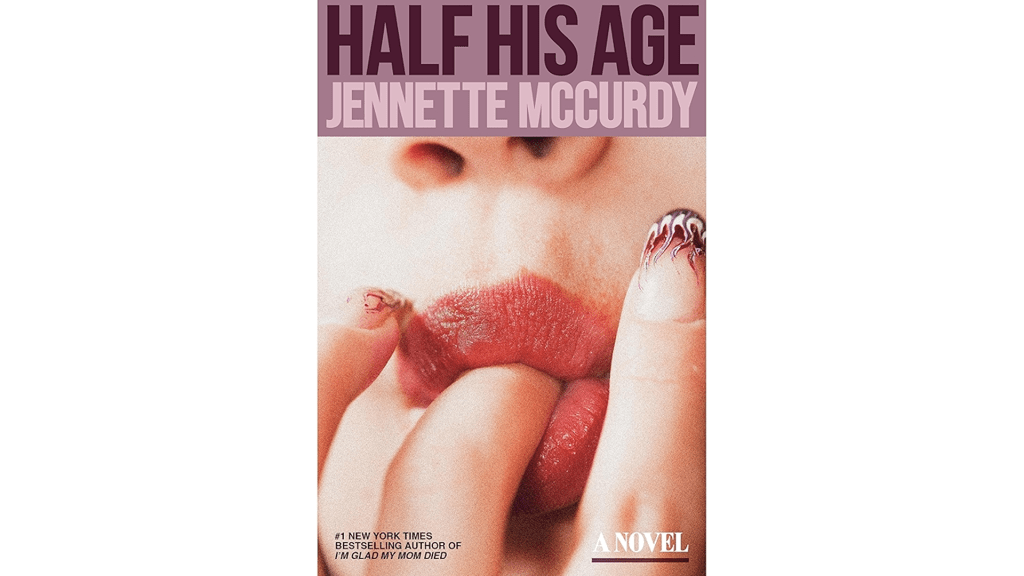
It was last night when I finished the audiobook edition of Half His Age, and during my daily dog walk this afternoon, I continued to digest the novel and process my thoughts. The book left me with many things to think about, some positive, some negative, and as I walked, the text of this review began to take shape. I had a bulleted list in my head by the time I reached my neighborhood again, and when I came home, I sat down to put in a quick review on Goodreads, which reads:
I really enjoyed McCurdy’s memoir, and so when I saw that she had published her first foray into fiction, I knew I had to give it a shot. I can only compare McCurdy’s debut novel to a bag of Chester’s Hot Fries (something I’m sure Waldo could appreciate). The book is sharply seasoned, addicting, devoid of any real nutrition, and by the end, mostly air.
Me, on Goodreads (enlarged to show detail)
After I wrote this and gave the book 3/5 stars, I hit publish, and despite all the thoughts I had while walking my dog, indifference washed over me like a sudden torrential rain, and I considered abandoning the enterprise of composing a larger review. I was done with the book and ready to move on. I asked myself why I felt this way, and in exploring that, I found that there was another layer to the impassive onion that was my reaction to the novel. This review, now, is just me trying to parse out my apathy.
And I’ve got to do it quickly before I forget everything I’ve just heard.
To nobody’s surprise, Jennette McCurdy herself provides the vocal talent for the audiobook. She supplements her wry, sardonic prose with a vocal performance that ought to be a match made in heaven; after all, both are her distinct voices. At times, this is indeed the case. She speaks quickly and fluidly, and to my delight, I didn’t have to increase the audiobook’s speed. Her deadpan demeanor and punchy, cynical cadence capture Waldo quite well. At other times, this tone becomes grating, even to the point of being utterly apathetic, as if reading McCurdy’s own words is somehow beneath her. It comes off as a teenager scoffing their way through a quippy One Act script, doing it only because their parents made them go out for theater.
But perhaps this is perfect for our protagonist, Waldo. The prose itself is tight and sharp, making for a vivid and engaging read. Sometimes it is trite, sometimes it’s too on the nose. But McCurdy is a good writer. Not a great one (yet), but she’s turned out an entertaining book. And I like Waldo enough. She’s smart, she’s irreverent, and she doesn’t beat around the bush. Sometimes she gets on my nerves; she has a tendency to point right in your face when a subtle nod might do (e.g. the Occam’s razor passage). Several times she is needlessly graphic. She’s a walking mess of contradictions, but so is every other teenager. She’s also a total loser, a joyless, friendless (well, except one), sarcastic loser.
Most importantly, though, Waldo is the victim of several people who ought to know better. Her quote-unquote “best friend” Franny is an airheaded Mormon who ought to treat Waldo as a person, not a charity case. Waldo’s mom is a perennially-heartbroken absentee mother who ought to see and validate her daughter’s feelings, but she tends to simply blow her off Waldo for any man who walks into her life. And then there’s Mr. Korgy, the object of Waldo’s intense infatuation, who ought to know that teachers shouldn’t date high school students. If anyone here is a loser, Korgy is the biggest one of them all. But in his apparent loserness, somehow he springs loose a deluge of desire within the 17-year-old. What follows is an affair between the two, a rollercoaster of sexual ecstacy, breakups, jealousy, and averted disaster, before the track plateaus and we are confronted with the mundanity of two partners ultimately growing complacent with each other.
The chief complaints I have seen online with the novel stem from two central disagreements. 1) it is too graphic and gross. 2) the voice is offputting and annoying. Both are understandable to a degree. Many people I see are pearl-clutching. I think that is a symptom of readers who do not venture past their own narrow preferences. There was little in this novel that phased me, personally. It is graphic and gross at times, more than I might prefer to read at any given time, but I came out unscathed. I cannot say the same for when I read American Psycho. To the second, I say that most readers were likely hoping for something more akin to I’m Glad My Mom Died. McCurdy’s voice in the memoir and her voice for Waldo are albeit very similar, nearing to self-insert at several points in the novel, but Waldo’s voice fluctuates in tone and malice and, yes, vulgarity. Look, I get it. I loved the memoir too. But if you came into this story expecting I’m Glad My Mom Died 2, you were to be sorely disappointed, which I fear to be the case for a number of McCurdy’s original literary fans.
So far as the plot goes, there’s little to want for a majority of the read. McCurdy keeps the story simmering nicely with her bite-sized chapters and snappy prose. But what I found myself wanting in the plot is probably the most imporant ingredient in this whole enterprise: stakes. That’s not to say there’s a lack of stakes here; Korgy has everything at stake in this relationship: his job, his marriage, his toddler son, his reputation. Waldo’s stakes are largely emotional. Important, of course, but only half the story. She runs the risk of being caught in the nuclear fallout should her relationship be discovered, but again, those stakes lie within the warhead Korgy continues to hit on the nose with a hammer. As a protagonist, she’s pretty insulated. She doesn’t care what any of her peers think, she has no mind for the people in Korgy’s orbit, and her mom may as well live on Pluto. Anytime the roller coaster of her relationship with Korgy took a sudden turn or plunged down a hill, the heightened stakes were almost always on Korgy’s end. Waldo starts the story as an Even Steven and ends the story as an Even Steven. I don’t think there was a risk that she would turn out any differently.
Since we’re here, let’s talk about that ending. Korgy books a trip to Hawai’i for himself and Waldo, and, following an inner prompting, she leaves him at the terminal. She goes home to find her mother intimate with her on-again, off-again boyfriend (after apparently swearing off men), and so Waldo decides to go off on her own and finally take the road trip her mother had been suggesting they do again since Waldo was a child. One can see the scenes playing out as they did in McCurdy’s head: the swells of music, the dolly shot as the camera tracks Waldo pulling her luggage past the airport gift shops and restaurants, and the final golden hour wide shot as her sputtering beater drives off into the sunset. Is it a surprise that McCurdy is already adapting the novel into a screenplay?
But I found myself a tad confused at this choice. Now, it’s entirely possible that I’m just a very stupid person. Perhaps it went over my head. I am by no means an expert in the literary canon. It seemed to me, though, that the novel just decided to end. It came without fanfare, it came without payoff, it came without catharsis. So far as I know, Waldo could end up back in Korgy’s arms in a week. At the airport terminal, she decides to trust her body, to validate and follow its lead, but was it not her body that suddenly, and without warning, turned on her hormones like a faucet the first time she met Korgy? We, the readers, know that it is more than a physical longing that draws her to Korgy. Waldo has a litany of emotional issues for which she ought to seek out a therapist, not a boyfriend. But these issues are left mostly unresolved, and the novel ends with Waldo in, more or less, the same spot she was in before it began. This novel, intending to be a meditation on authenticity, rage, and self-discovery, ends with a startling lack of clarity on any of these three major throughlines. Apathetic to them, if you will. Cursed to do it all over again in a month.
If that is the point, I ask why? Is it that even a months-long relationship of sexual abuse need not necessarily end with everything neatly wrapped in a bow? I am not asking for that, nor do I seek definitive answers to any these themes; at worst, I might only wish to be left with further questions to ponder. But I am not left with anything. The story ends, I take off my headphones, and scratch my head. That’s that, I guess.
I don’t see this novel doing nearly as well as I’m Glad My Mom Died. It came out two months ago, and it’s mostly dropped out of the larger conversation of the internet since. As a debut novel, it serves well enough, but as the second book from a writer who spent 80 weeks on the New York Times Best Seller List, it had a high bar to clear and missed. I think if this manuscript came from an entirely unknown author, it would have undergone heavy revision before finally reaching bookstore shelves. People did not clamor for I’m Glad My Mom Died because they were salivating at the thought of reading McCurdy’s style of deadpan snark for 300 pages. The memoir sold like hotcakes because people wanted to read the truth. Her truth. An invisible truth that unfolded over the course of decades while we all laughed and clapped and waved our little feet watching Sam Puckett beat nerds and bullies with a sock full of butter on iCarly. Half His Age is not a story that needed to be told. I’m Glad My Mom Died is.
In reading this novel, one can’t help but compare it to similar work. It lacks the depth of Nabokov, the flair of O’Connor, and the joy of Oates. It is engrossing, it is irreverent, it is gross, it is graphic, it is funny, it is childish. It is many things. A whole, sound story, though? I’m not certain, and I’m too apathetic toward it to consider reading or listening to it again.
If you haven’t already, you can subscribe to my mailing list here and get new fiction and blog posts sent directly to your inbox!
 ethanswick.com
Leave a comment